Brazil at World Cup 2026: Nine Forwards, One Italian, and the Math of a Sixth Star
Carlo Ancelotti named Brazil's 26 on May 18, 2026, and the headline was 79 goals tall. Neymar is back, at 34, after an ACL absence that began in October 2023. Casemiro keeps the armband.

Group C analysis · OLTA.football
The squad, in one paragraph
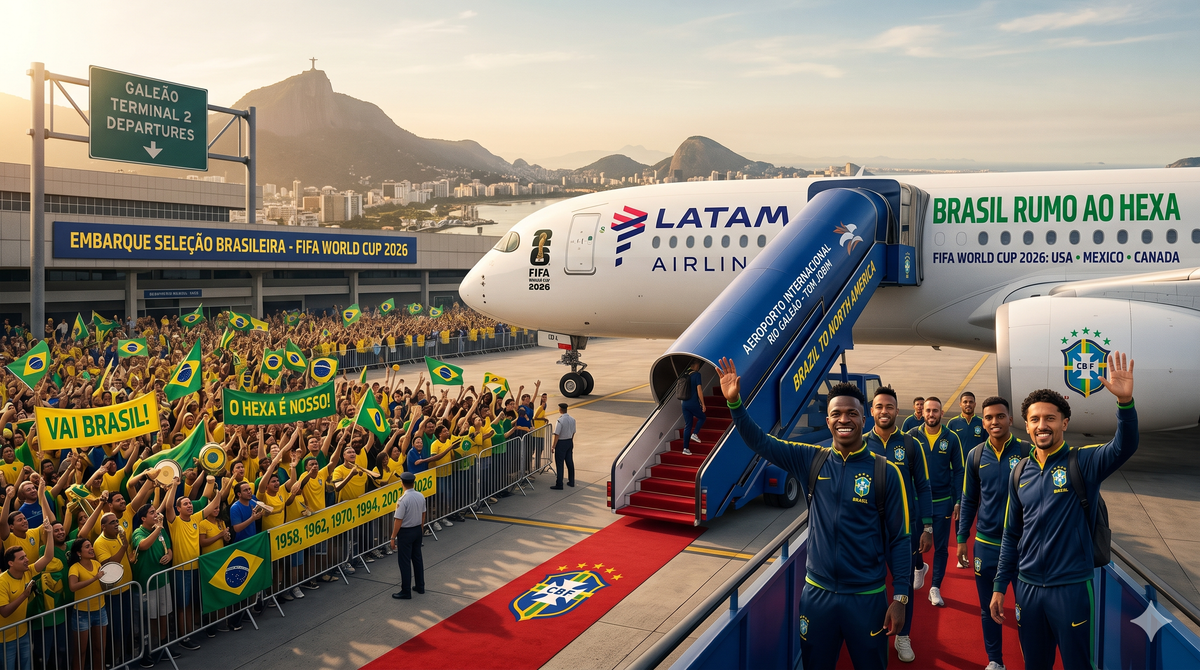
Carlo Ancelotti named Brazil's 26 on May 18, 2026, and the headline was 79 goals tall. Neymar is back, at 34, after an ACL absence that began in October 2023. Casemiro keeps the armband. Out: João Pedro, Richarlison, Andrey Santos, Bento, the 41-year-old Thiago Silva. In: a Bournemouth teenager named Rayan who has played a senior international friendly and not much else. Ancelotti named nine forwards and only five midfielders — an unusual ratio that telegraphs the plan: get the ball forward, get pace on the field, decide games in the final third.
That ratio is the entire thesis.
How they got here, and why that matters
The Brazil that arrives in North America is not the Brazil of qualifying-cycle dominance.
| Cycle | Record (W-D-L) | GD | Finish |
|---|---|---|---|
| 2018 | 12-5-1 | +30 | 1st |
| 2022 | 14-3-0 | +35 | 1st |
| 2026 | 8-4-6 | +7 | 5th |
Brazil limped through qualification with 8 wins, 4 draws and 6 losses, finishing fifth with a +7 goal differential, a collapse from the +30 and +35 they posted in the prior two cycles. Three managers passed through before Ancelotti arrived. Dorival was sacked after a 4-1 loss to Argentina in Buenos Aires; Ancelotti was appointed in May 2025 and sealed qualification a month later with a 1-0 win over Paraguay. Vinícius scored the only goal.
The scoring problem is what jumps off the page. Brazil scored 24 goals across 18 qualifying matches, only 1.33 per game. For a side that produces forwards the way the Arctic produces polar bears, that is a structural failure. The 2022 qualifying side, by comparison, averaged 2.05 goals per match.
Under Ancelotti's first ten games in charge, Brazil have gone 5-2-3, averaging 1.70 points per match, this is not commanding. The recent friendly form is genuinely mixed: a 2-3 loss to Japan, a 2-0 win over Senegal, a 1-1 draw with Tunisia, a 1-2 loss to France, and a 3-1 win against Croatia. The team that lost to Japan and France in friendlies is the team boarding the plane. That cannot be assumed away.
The Vinícius dependency
Strip away the romance and Brazil's attacking plan is one player.
Vinícius Júnior's 2025-26 club season at Real Madrid is 16 goals and 6 assists in 36 La Liga games across 2,825 minutes; 100 shots, 46 on target, a non-penalty xG of 14.42 ~ top-5% among La Liga players. He is having a very good year, and Real Madrid's Champions League exit at Bayern means he ends the club season without silverware momentum, this is not a Ballon d'Or year, and has to be impacting him mentally at some level.
The tactical setup is built around him. Ancelotti coached Vinícius for four seasons at Madrid and knows the patterns; Brazil's full-backs tuck inside to feed him isolation matchups, a tactical commitment built around his strengths. Ancelotti favours a 4-3-3 with Casemiro screening the back four and inverted full-backs feeding Vinícius on the left.
One nuance worth flagging from the season data: Vinícius played fewer games as a centre-forward but was statistically more lethal there. 10 goals in 15 appearances in the central role. Ancelotti has the option to slide him inside if Raphinha and Martinelli are giving him width. It is a card he has not yet shown for Brazil. He may at the World Cup.
Red-team this: the prediction Brazil's tournament hinges on Vinícius hitting form is so consensus it is almost a cliché. But consensus is sometimes right. The squad is structured around him; the manager has eight months of patterns with him; the alternative talisman is a 34-year-old playing in São Paulo state football. If Vinícius is muzzled by injury, by a deep block, by a tactical answer Brazil does not have a clean Plan B.
The Raphinha case
Per-90 numbers tell a different story than the depth chart. Raphinha's 2025-26 at Barcelona: 13 goals in 22 La Liga games, an npxG that puts him in the top 1% of the league, and last season's La Liga Best Player award. His 0.84 goals per 90 outpaces Vinícius's 0.51. For Brazil, he has 11 in 37 caps, a better international rate than the man billed as the talisman.
Why is he not the centerpiece, then? Two reasons. First, Ancelotti's tactical fluency: Vinícius is the player the manager has the deepest film on. Second, durability. Raphinha played 1,389 minutes in La Liga this season to Vinícius's 2,825. A seven-game tournament is unforgiving to half-fit wingers.
Brazil's ceiling requires both he and Vini to be at the top of their game. If Raphinha arrives healthy, the left-right combination is the most productive winger pairing at the tournament. If he doesn't, Brazil's attack is one Vinícius hamstring away from collapse.
The Neymar question, treated honestly
Neymar at Santos this season: 6 goals and 3 assists in 13 matches. He has not played senior international football since the ACL tear in October 2023. He is the all-time top scorer for the country. He is 34. Ancelotti kept him in the preliminary plans understanding that he remains one of the most important players in modern Brazilian football history — which is a polite way of saying the call was as much cultural as tactical.
The defensible reading: Neymar is a 30-minute weapon and a dressing-room anchor. The indefensible reading: he starts ahead of Paquetá or Cunha because he is Neymar. Ancelotti's track record suggests the former. His record with Real Madrid's veterans suggests he is unsentimental when minutes start to hurt the team.
The honest question for the tournament: can Neymar's body handle three games in nine days if Brazil reach a quarterfinal? The 2022 evidence (he played all five of Brazil's matches in Qatar before the Croatia exit) is two ACL operations old. We don't know. Ancelotti doesn't know. He is betting that knockout-stage 60-minute Neymar is worth more than another midfielder. It is a defensible bet. It is also a bet.
Strengths
1. The wing depth is absurd. Raphinha, Vinícius, Martinelli, Matheus Cunha, Luiz Henrique, Endrick, Rayan. Brazil look especially strong in attack, with plenty of quality options available, and the squad construction of 9 forwards means Ancelotti can rotate aggressively across the group stage and arrive at the knockouts with fresh legs in the wide channels. Against tired full-backs in a Round-of-16 game, Endrick or Rayan off the bench in the 65th minute is a problem most opponents do not have an answer for.
2. The goalkeeping is best-in-tournament. Alisson remains, by xG-saved metrics and one-v-one data, one of the top three in the world. Advanced data still rate him as one of the best in the world at one-on-ones and cross-handling. Éderson and Weverton are credible deputies. In a tournament that historically gets decided in penalty shootouts or single moments of goalkeeping, this matters more than most analyses credit.
3. Ancelotti's knockout pedigree. He has won each of Europe's top five leagues and is the most decorated Champions League manager of all time. International football is not club football, but the meta-skill, managing rest, rotating squads, winning two-legged ties on aggregate, surviving knockout pressure translates better than people pretend. He has never lost a Champions League final. That is not nothing.
4. Casemiro–Bruno Guimarães is a real midfield pivot. Both have had functional, not stellar, club seasons, but their international chemistry is established. Bruno's progressive passing from deep is a release valve when teams press Brazil's centre-backs.
Weaknesses
1. The midfield is thin. Five midfielders for a 26-man squad is light, and one of them (Danilo Santos of Botafogo) is a project pick. If Casemiro or Bruno Guimarães picks up a suspension or a knock, Brazil are asking Fabinho who is at Al-Ittihad, away from elite European rhythm to start a knockout game. Paquetá covers some of this as a No. 10 dropping deep, but the central depth chart is the squad's clearest single point of failure.
2. The full-backs are a generation in transition. Alex Sandro is 35 and at Flamengo. Danilo is 34. Douglas Santos plays in Russia. Wesley (Roma) is the future; he may not be the present. The inverted full-back model Ancelotti wants demands technical sharpness in possession, and a 35-year-old left-back is not the obvious solution to that demand.
3. Goal-scoring from open play. This is the one that genuinely should worry supporters. Across 18 qualifying matches, Brazil scored only 24 goals and the friendly data under Ancelotti is uneven. Brazil have not played a tournament knockout game against a structured European mid-block with a coherent answer to it since 2018. They have lost to Belgium (2018), Croatia (2022), and have been outscored in penalty shootouts twice in the last three cycles.
4. The Argentina shadow. Not in Group C, but worth naming. A 4-1 loss to Argentina in Buenos Aires is in the recent memory of every player on this plane. If they meet in a semifinal, the psychological asymmetry is going to impact play
How to exploit Brazil
The pattern is not subtle, and you can take this as the section opposing coaches' analysts are already writing.
Press the build-up centrally. Brazil's centre-backs (Marquinhos, Gabriel Magalhães, Bremer) are excellent in 1-v-1 defending but their build-up under sustained press is mediocre. Marquinhos is the only one comfortable progressing the ball through lines under pressure. A 4-4-2 mid-block that funnels them into Casemiro and traps him is the template. France ran it in March (1-2 win for France). Japan ran a version of it (2-3 win for Japan).
Force the right side. Brazil's tactical commitment is built around Vinícius on the left. The flip side: their right side, depending on lineup, is Wesley or Danilo behind Raphinha or Cunha. Overload that side, force Brazil's possession to enter through their less-rehearsed channel, and the attacking patterns become noticeably less coherent.
Beat them in the air. Brazil's centre-backs are 6'0", 6'2", 6'0". Capable but not dominant. Scotland, their final group game, already know this is their lever. Set-piece-heavy sides (Morocco less so, Scotland very much so) have a path here.
Survive the first 60. Endrick, Rayan, Igor Thiago: these are bench-impact players. If you keep the game level to the 70th minute with Brazil's first XI on the field, the bench-vs-bench matchup is in their favour. The way to beat them is to win the game in regulation against the starting XI.
Group C: the actual problems
| Date | Opponent | Venue | Read |
|---|---|---|---|
| Jun 13 | Morocco | New York/New Jersey | The hardest match in the group |
| Jun 19 | Haiti | Philadelphia | Bench game; rotation |
| Jun 24 | Scotland | Miami | Set-piece test |
Brazil's World Cup 2026 journey kicks off on June 13 against Morocco at the New York/New Jersey Stadium, then Haiti on June 19 in Philadelphia, before concluding the group stage on June 24 in Miami against Scotland.
Morocco is the game that matters. They reached the 2022 semifinals with a defensive structure that is still largely intact, and their press will test exactly the Brazil weakness identified above. A draw in the opener is a real outcome to price in. Haiti is a rotation game expect Endrick, Rayan, Igor Thiago minutes. Scotland in Miami in June is the worst possible combination of opponent style (set-piece heavy, physical) and conditions (heat, fatigue at the end of group stage) for Brazil.
Realistic group-stage range: 7 points (most likely) to 9 points (clean sweep). 6 points is in play. Anything less is a crisis.
Probable outcome — a heuristic, not a model
Caveats stated up front: this is a read, not a Monte Carlo output. We will publish the actual simulated probabilities once the platform's prediction engine ingests the final 48 squads.
Working from the data we have:
- Win the group: ~65%. Morocco is real but Brazil should still be group favourites.
- Reach quarterfinals: ~55%. The Round of 16 will likely give them a runner-up from a middle group — eminently winnable, but not free.
- Reach semifinals: ~30%. This is the gate. Recent history (four QF exits in five cycles) and the squad's structural weaknesses suggest this is roughly where Brazil's tournament ends in the median case.
- Reach the final: ~15%.
- Win the tournament: ~8-10%.
For context, the major books currently price Brazil at the second or third favourite, roughly 12-14% implied probability of winning. Our read is they are a slight overlay the squad has more flaws than the brand suggests, and the qualifying data is not noise.
Single-line prediction: Brazil wins Group C, beats their Round-of-16 opponent, and goes out in the quarterfinals to a top-tier European side (France, England, or Spain depending on the bracket). The fifth consecutive QF exit since 2002. The story of 2026 is whether Ancelotti's project survives a sixth straight tournament without an additional star over their crest.
If I am wrong, the way I am wrong, is that Raphinha or Vinícius Júnior have the tournament of their lives and Ancelotti's knockout management squeezes one more game out of this squad than the sum of its parts deserves. That is the bull case.
Built on OLTA.football. All metrics current as of May 20, 2026.